How To Spot A Fake Cartier Watch
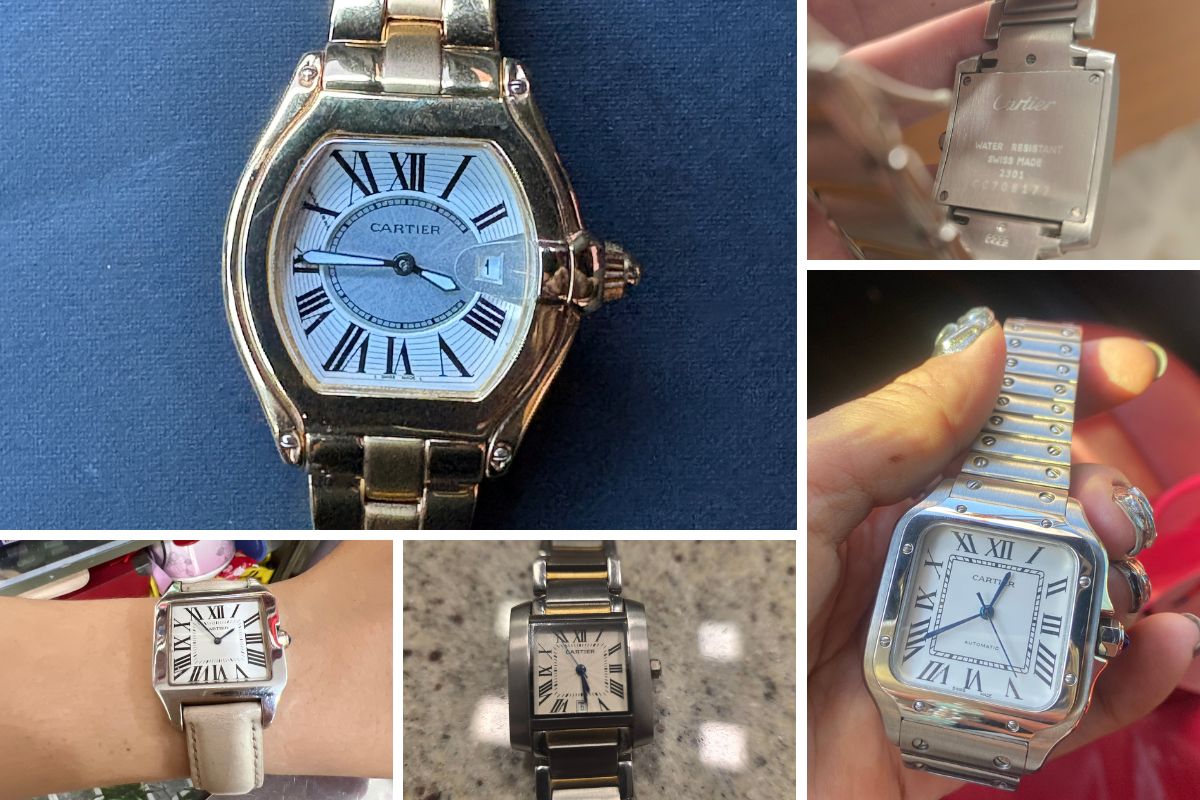
Few watch brands rely as heavily on design precision as Cartier. The shape of a Tank case, the alignment of Santos bezel screws, and the exact font of Roman numerals are deliberate and consistent across generations. That discipline stems from Cartier’s origins as a fine jewelry house. Long before becoming a major name in watchmaking, Cartier built its reputation on meticulous craftsmanship, strict aesthetic codes, and exacting finishing standards. That same approach carries into its watches, where proportion, symmetry, and surface treatment are carefully controlled.
That consistency makes Cartier watches easier to recognize, but it also makes them popular targets for counterfeits. Many fake Cartier watches succeed at copying the overall look, but they fall short in proportion, finishing, and subtle design cues that experienced collectors notice immediately. Here’s how to spot a fake Cartier watch before it becomes an expensive mistake.
How To Spot A Fake Cartier Watch Step #1: Research The Reference
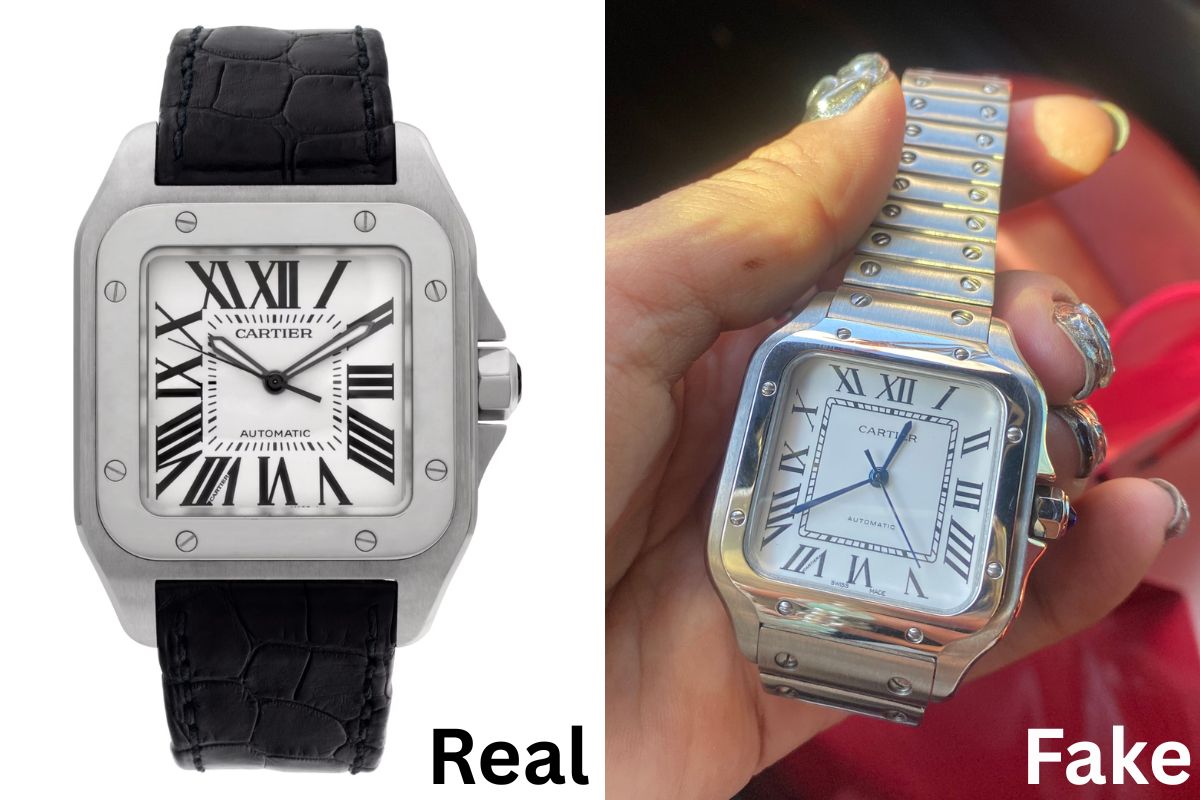
Cartier’s catalog is broader and more varied than many buyers realize, which makes model-specific research especially important.
For instance, the Tank alone includes the Tank Louis Cartier, Tank Must, Tank Américaine, Tank Française, and others, each with distinct case shapes, proportions, and dial layouts. Furthermore, the Santos line spans multiple generations, such as the Santos Galbée, Santos 100, Santos Dumont, and the modern Santos models equipped with the QuickSwitch bracelet system. The Ballon Bleu is produced in numerous sizes, materials, and both quartz and automatic versions.
Replica manufacturers frequently combine details from different references. A dial from one model may appear in a case that never housed it. An automatic movement may be placed inside a watch that was only ever offered in quartz. These inconsistencies are common in replicas.
To avoid this, start by confirming:
- The exact case dimensions and material for the specific reference
- Whether the model should be quartz, manual-winding, or automatic
- The correct dial configuration, including Roman numeral layout, guilloché work, railroad minute track, “Swiss Made” placement, and Cartier’s hidden signature
- The proper bracelet or strap system
If the watch does not match a documented Cartier production reference, that is your first significant warning sign.
How To Spot A Fake Cartier Watch Step #2: Inspect The Design Details
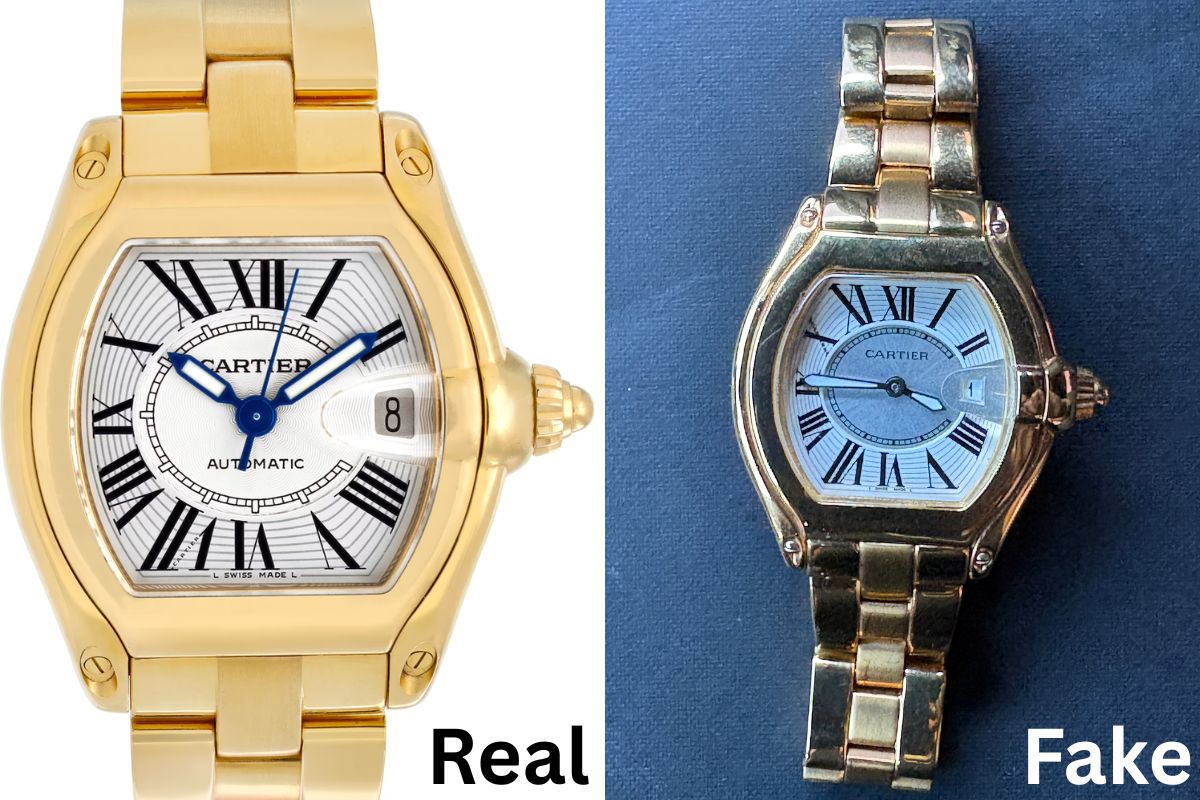
Once you’ve confirmed the reference is legitimate, the next step is to evaluate how well the watch is executed. Counterfeits often capture the general look but struggle with refinement and consistency.
Case and Bracelet Finishing
Cartier cases are sharply defined and cleanly finished. Transitions between brushed and polished surfaces should be precise, with clear separation between textures. Cartier does not blur finishes or leave uneven polishing marks. Replicas often struggle here, resulting in soft edges or inconsistent surface treatment.
Many Cartier bezels and bracelets feature exposed screws, particularly on models like the Santos and Panthere. These are functional screws, not decorative elements. Because they are real screws, slight variations in alignment are normal and not a sign of a fake. However, authentic Cartier screws always have flat-head slots. If you see Phillips-head screws, that is an immediate red flag.
Bracelet finishing is another area to inspect closely, especially on the underside. Cartier pays attention to surfaces not immediately visible. If the bracelet feels rough, sharp, or unfinished when handled, that lack of refinement should raise concern.
Dial Execution, Printing, and Typography
Cartier dials follow a set of long-established design codes that remain remarkably stable across collections. Understanding them makes spotting inconsistencies easier.
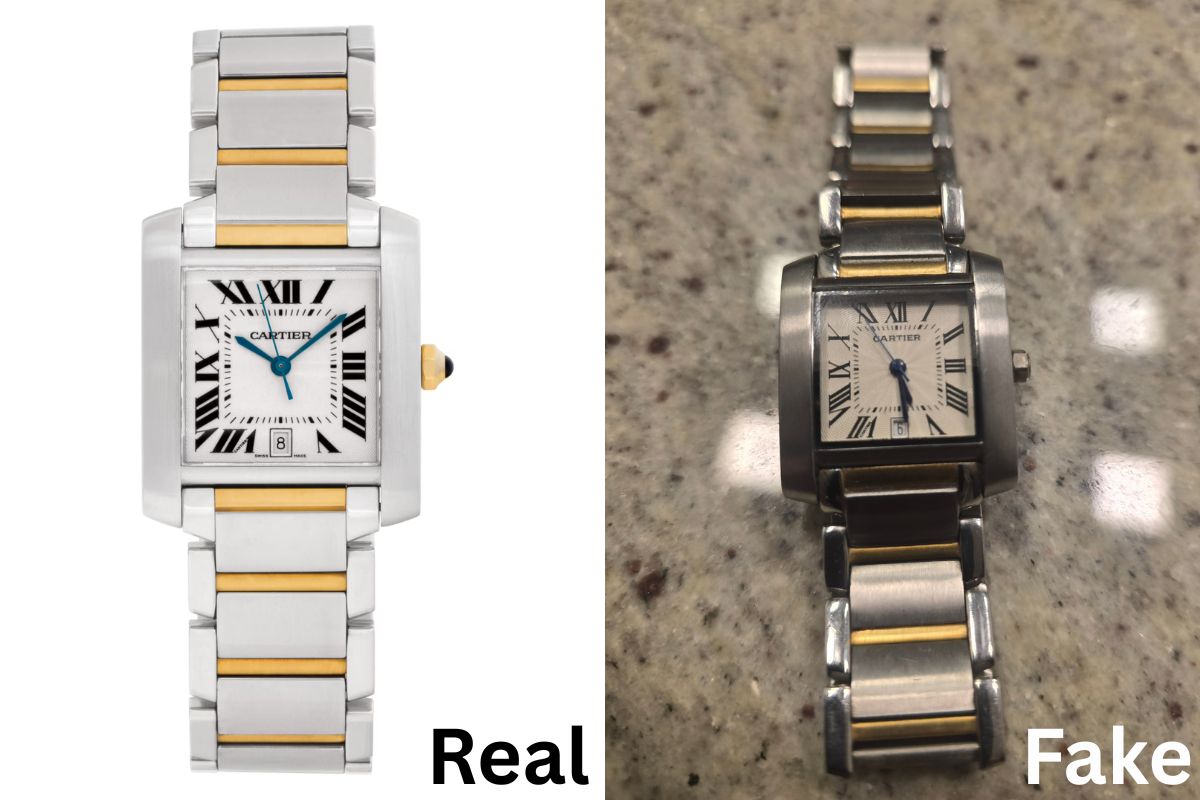
Most classic Cartier models feature black Roman numerals that are slightly elongated and radiate outward from the center of the dial. The spacing should be precise and balanced. The numerals are never thick, distorted, or uneven. If the printing looks heavy, misaligned, or poorly inked, that is a warning sign.
Many models also include the signature “rail-track” minute scale, a double line with a minute track that resembles railway lines. This track must be perfectly centered and aligned with the hands and numerals. On counterfeit watches, the minute track is often too thick, too thin, or slightly off-center.
Blued sword-shaped hands are another Cartier hallmark. The blued hands should have a rich, even tone, not a painted or dull finish. The second, minute, and hour hands should be the exact same shade of blue. Uneven coloration or flaking signals trouble. One important exception applies to Collection Privée Cartier Paris (CPCP) models produced between 1998 and 2008. These watches, identified by the “Cartier Paris” inscription on the dial, often feature Breguet-style blued hands rather than the standard sword-shaped design.
Look carefully for Cartier’s secret signature, discreetly integrated into one of the Roman numerals, often within VII or X, depending on the model. On authentic pieces, this signature is sharply defined and correctly scaled within the numeral. On fakes, it may appear blurry, oversized, poorly positioned, or missing entirely.
If the dial features guilloché decoration, the pattern should be clean and symmetrical, often forming a sunray or wave motif. The texture should feel intentional and crisp, not stamped or shallow.
Finally, examine the smaller details. The “Swiss Made” text must be correctly spaced and centered. If the watch includes a date window, the font and alignment of the date disc should match known authentic examples for that reference. Cartier uses consistent typography, and counterfeiters frequently get the proportions slightly wrong. When it comes to Cartier, the dial is rarely sloppy. If something looks slightly off, it usually is.
Crown and Cabochon
Cartier crowns are distinctive and carefully executed, reflecting the Maison’s jewelry heritage as much as its watchmaking. Most models feature either a beaded crown or a faceted crown, set with a blue cabochon. This cabochon is either synthetic spinel (for steel models) or sapphire (for precious metal models), depending on the reference. In a few limited-edition pieces, the cabochon is a ruby.
The cabochon should be smooth, well-set, and properly proportioned to the crown. It should not wobble or appear glued in place. The color is typically a rich, even blue, not pale or cloudy.
On the Ballon Bleu, the crown is partially integrated into the case design. The curvature and fit should be seamless. Any gaps or awkward transitions between crown and case deserve scrutiny. Together, these small design details often reveal more than the logo ever could.
How To Spot A Fake Cartier Watch Step #3: Examine Engravings
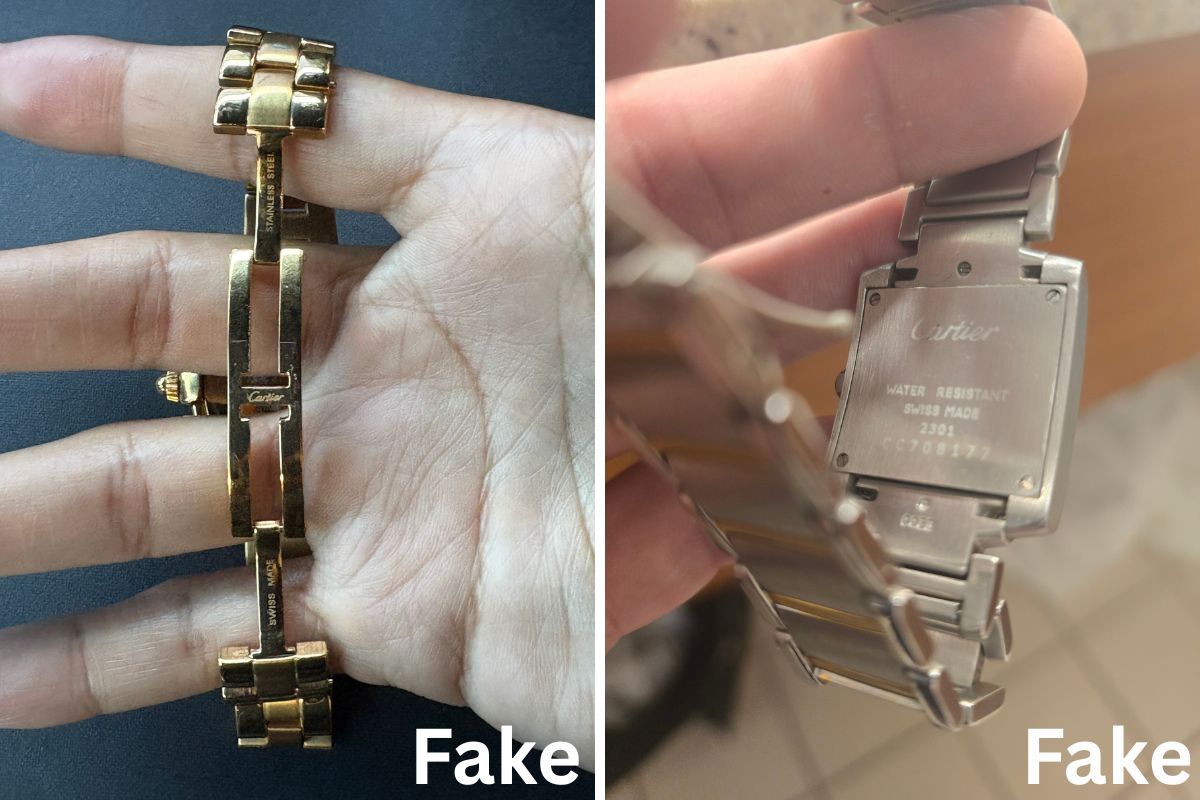
Once the external design checks out, turn the watch over. Cartier engravings are clean, deeply executed, and consistent in formatting. Counterfeits sometimes get the basics right but miss subtle details in spacing, alignment, and font weight.
Most authentic modern Cartier watches will include several of the following engravings, depending on the model and movement type:
- Cartier (brand signature)
- SWISS MADE
- Case material (e.g., Stainless Steel or AU 750)
- Serial number
- 4-digit case number
- Water Resistant (if applicable)
Movement type is also reflected on the caseback:
- If the watch is self-winding, it will typically be engraved “Automatic.”
- If it is manual-winding, it will usually read “mécanique.”
- If the watch is quartz, the caseback typically does not state “Quartz.”
Engravings on a genuine Cartier are clean, evenly spaced, and sharply cut. The depth should feel intentional, not faint or inconsistently etched. Fonts are flawless and proportional. On counterfeit examples, you’ll often see shallow laser etching, uneven spacing, incorrect font weight, or inconsistent alignment.
Serial numbers should be unique and cleanly engraved. Repeated serial numbers across multiple watches are a major red flag. As always, confirm formatting and placement against the exact model and production era, since Cartier has adjusted layout details over time.
How To Spot A Fake Cartier Watch Step #4: Check The Movement
The movement is where authenticity becomes much harder to fake. While many Cartier watches are quartz, the Maison also produces a wide range of automatic and manual calibers, including in-house movements.
If the watch is automatic or manual-winding, pay close attention to how it winds. A genuine Cartier should feel smooth and precise. Coarse winding, gritty resistance, or excessive play in the crown can indicate a low-quality generic movement inside.
Another red flag to look for is a ghost date. This happens when a watch has a crown position that adjusts a date, but the dial has no date window. Counterfeiters often use inexpensive mass-produced movements and simply omit the visible date display. If the crown pulls out to an extra position that serves no visible function, that is a sign of a fake Cartier watch.
When possible, inspect the movement finishing. Authentic Cartier movements, even outsourced ones, are cleanly assembled with consistent finishing. Engravings should be sharp and properly aligned. Bridges should not look raw or unfinished. Screws should not appear discolored or poorly seated. If the movement looks generic, overly industrial, or lacks a Cartier signature where one should be present, proceed with caution.
Finally, confirm that the movement type matches the reference. Cartier frequently produces the same model in both quartz and automatic versions. A mismatch between what the reference number indicates and what the watch actually contains is one of the most common counterfeit mistakes.
How To Spot A Fake Cartier Watch Step #5: Buy From A Reputable Seller

Even with careful research and close inspection, authentication can be difficult without experience. Cartier’s consistency in design makes details easier to evaluate, but high-quality counterfeits continue to improve. That is why the safest approach is to buy from a trusted and established seller.

A reputable dealer will verify serial numbers, inspect the movement, confirm reference specifications, and evaluate condition before offering a watch for sale. They should also provide clear return policies and stand behind the authenticity of every piece they sell.

At Gray & Sons, every pre-owned Cartier watch is carefully examined by experienced watchmakers and specialists before it reaches the showroom. From case construction and dial execution to movement integrity and engravings, each detail is evaluated for authenticity.

When purchasing a high-value timepiece, peace of mind from buying from a reputable source matters most. In the world of luxury watches, authenticity is everything.