How To Spot A Fake Rolex - A Gray & Sons Guide
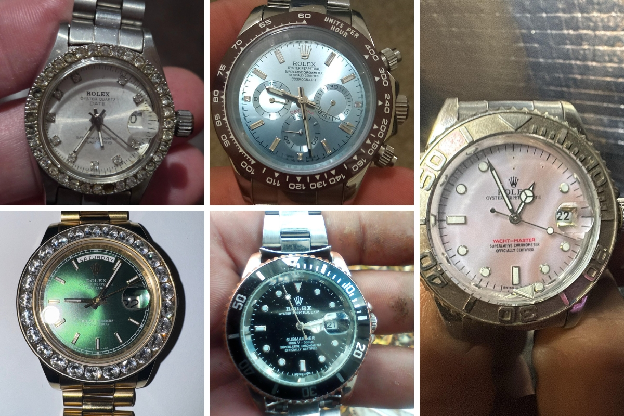
Rolex is the most recognizable luxury watch brand in the world, and that global demand has made it the most counterfeited watch brand as well. From obvious knockoffs to increasingly sophisticated replicas, fake Rolex watches exist at every level of the market, often designed to deceive even experienced buyers at a glance.
While obvious red flags still exist, high-end modern counterfeits have become difficult to identify without careful examination. Small details in finishing, proportions, and movement quality often reveal the difference, but those details are not always apparent at first. Knowing where counterfeit Rolex watches tend to fall short, and when expert authentication becomes essential, is a critical part of buying with confidence in today’s secondary market.
Understanding Modern Rolex Counterfeits
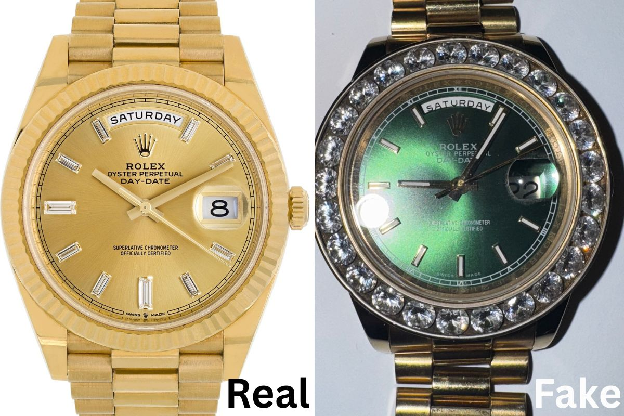
Today’s counterfeit Rolex watches fall into two broad categories. At the low end are poorly made fakes with obvious flaws in materials, printing, and finishing. At the other extreme are high-end replicas (sometimes known as Rolex super fakes) designed to closely mimic genuine models, sometimes using highly convincing movements and watch parts. Some even replicate weight, engraving styles, and external finishing well enough to fool an untrained eye.
The differences are often subtle, but they can become clear when examining details such as movement architecture, case finishing, and component quality.
Steps to Spot a Fake Rolex #1: Understand The Core Hallmarks
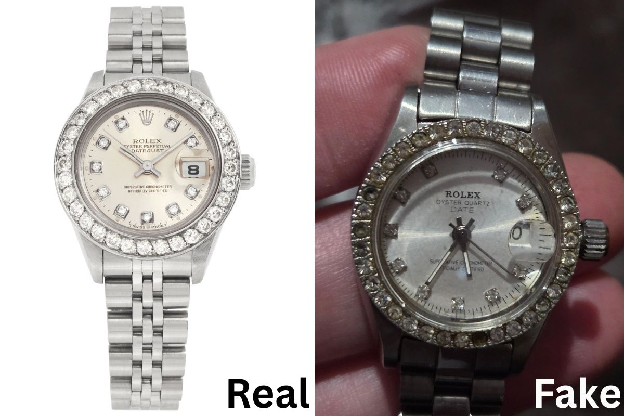
Before examining any individual watch, the most effective way to spot a fake Rolex is to understand the brand’s non-negotiable design standards. Modern counterfeits don’t often fail in one obvious way, but across several small details.
Start with these fundamentals:
- Materials: Modern Rolex watches are made exclusively from 904L stainless steel (now branded as Oystersteel), 18k gold, or 950 platinum. Since 2008, Rolex has also used its proprietary 18k Everose gold. If a non-vintage Rolex feels unusually light, shows rapid discoloration, or uses plated metals, it should raise immediate concern.
- Water Resistance: Every modern Rolex Oyster case features a screw-down crown and a screw-down caseback. Current Oyster Perpetual models are rated to a minimum of 100 meters of water resistance. This standard does not apply to non-Oyster collections such as the Cellini or Perpetual 1908.
- Date Magnification: With the exception of older Sea-Dweller references and the Deepsea family, Rolex watches with a date function are fitted with a magnification lens called the Cyclops that protrudes above the crystal, magnifying the date approximately 2.5 times. The absence of a Cyclops on a date-equipped Rolex should always prompt closer inspection.
- Number engravings: On a Rolex case, the model (reference) number is engraved between the lugs at the 12 o’clock position, while the unique serial number is engraved between the lugs at the 6 o’clock position on watches produced before the early 2000s, requiring bracelet removal to view. These engravings should be crisp, deep, and precisely executed. Poorly cut, shallow, or uneven engraving is a common warning sign. Rolex watches produced after the early 2000s no longer include the serial number between the lugs, as it is now engraved on the rehaut (more on that below).
- Crystal and Rehaut Details: Since the early 2000s, Rolex has laser-etched a tiny coronet at the 6 o’clock position on the sapphire crystal. Around the same period, the inner rehaut (the space between the crystal and the dial) began featuring repeated “ROLEX ROLEX ROLEX” engravings, with the serial number etched at 6 o’clock. Poor alignment, incorrect fonts, shallow engraving, or missing details are common counterfeit errors.
- Bracelet and Model Pairings: Rolex does not mix bracelets arbitrarily. Certain models are only offered on specific bracelets. A bracelet that does not match the reference can indicate aftermarket parts or a non-authentic watch. Study which Rolex bracelets — Oyster, Jubilee, President, Oysterflex, Pearlmaster, and leather — are meant to accompany which models.
Steps to Spot a Fake Rolex #2: Research The Specific Model/s
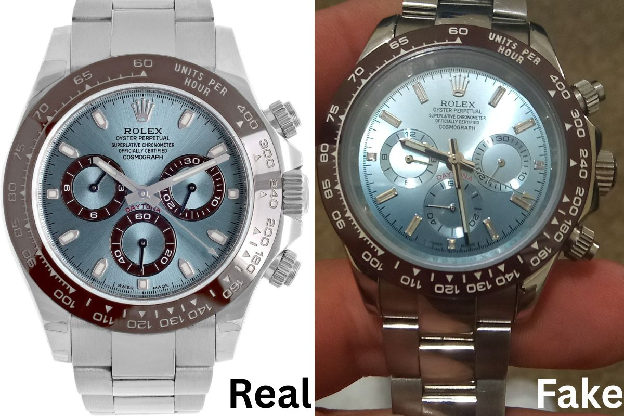
Once you’ve narrowed your search to a specific Rolex, the next step is to research that exact reference, not just the model name. Rolex reference numbers identify the precise configuration of a watch, including case material, bezel type, bracelet, and sometimes even the dial style. This is critical because many counterfeit watches combine real-looking elements into combinations that Rolex never produced.
Start by confirming that the reference you’re considering actually exists. Official brand resources, reputable watch publications, and established secondary-market dealers are your best sources. Pay close attention to case size, metal, bezel style, and bracelet pairing. If any of those elements don’t align with known production details, something may be wrong. For example, the Rolex Day-Date has only ever been produced in precious metals, never stainless steel; the Submariner has never been offered in Everose gold or platinum; the GMT-Master has only been produced in 40mm sizes; and the Datejust has never been paired with the Oysterflex bracelet. The more research you do, the easier it becomes to spot inconsistencies.
It’s also important to understand the difference between a reference number and a serial number. The reference identifies the model itself, while the serial number is unique to the individual watch and can help estimate its production period. A mismatch between a watch’s configuration and its supposed production era is another cause for concern.
Finally, compare pricing. While the secondary market fluctuates, legitimate Rolex watches tend to trade within well-established ranges. If a watch is priced significantly below market value with no clear explanation, that alone warrants caution. Deep discounts are one of the most common warning signs when dealing with counterfeit or heavily altered watches. As always, if it sounds too good to be true, it probably is.
Steps to Spot a Fake Rolex #3: Inspect the Details Carefully
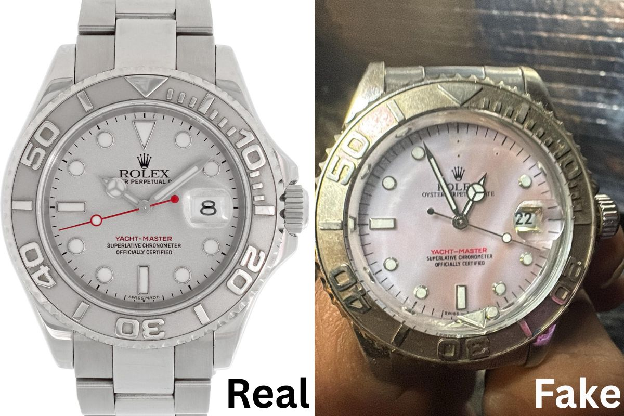
Once you understand Rolex’s core standards and have researched the specific reference, the next step is a close inspection — whether via detailed photographs or, ideally, in person. This is where many counterfeit Rolex watches begin to reveal themselves.
- Dial printing and layout are one of the most common failure points. On a genuine Rolex, text is crisp, evenly spaced, and perfectly aligned. Lettering should never appear fuzzy, thick, or uneven under magnification. Pay close attention to the coronet logo, minute track, and any model-specific text such as “Submariner,” “Daytona,” or “Chronometer.” Inconsistencies in font weight, spacing, or placement often indicate a problem.
- Hands and hour markers should be precisely finished and correctly proportioned. Rolex hands are sharply cut, well-polished, and filled cleanly with luminous material (vintage references may lack lume). Hour markers should sit perfectly aligned and be securely applied. Sloppy lume application, crooked markers, or mismatched finishes are all warning signs.
- Case finishing is another area where replicas struggle. Rolex cases have well-defined edges, consistent brushing, and smooth transitions between polished and brushed surfaces. Overly sharp edges, uneven brushing, or poorly finished chamfers suggest substandard manufacturing — or, at a minimum, a poorly polished or a Frankenstein watch.
- Finally, listen to the movement. A genuine Rolex automatic movement produces a smooth, quiet sound. If the watch can be opened and the movement inspected, this can be an effective way to identify a fake, as replica movements are typically not built or finished to the same standard as genuine Rolex calibers. That said, as counterfeiters grow more sophisticated, some high-end replicas now use movements that closely resemble authentic ones.
Steps to Spot a Fake Rolex #4: Watch Out For Common Red Flags
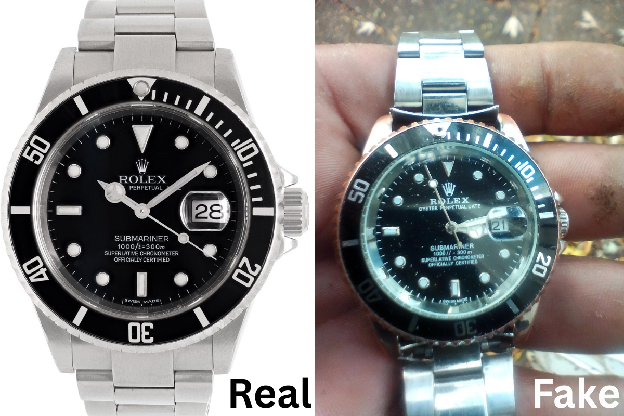
While modern replicas can look convincing, there are several telltale details that should immediately raise concern when evaluating a Rolex watch.
- Display casebacks are one of the most obvious warning signs. For the vast majority of its history, Rolex has used solid casebacks. Only in recent years has the brand introduced sapphire crystal casebacks on select models, most notably certain Daytona chronographs and the Perpetual 1908 collection. A Rolex with a clear caseback outside of these limited exceptions should be approached with caution.
- Engraved exterior casebacks are another frequent issue. With very few exceptions — such as the Sea-Dweller, certain COMEX-issued pieces, Milgauss models, and some military-issued watches — Rolex does not engrave logos, slogans, or decorative text on the outside of the caseback. By contrast, the inside of a genuine Rolex caseback is always engraved with reference number. Decorative engravings on the exterior are a common counterfeit trait.
- Quartz movements in modern Rolex watches are also a clear cause for concern. While Rolex did produce quartz models in the past (including the Beta 21, Oysterquartz, and some vintage Cellini references), all modern Rolex watches are powered by automatic mechanical movements. A once-per-second ticking seconds hand on a contemporary Rolex is a clear indication of a fake. Genuine modern Rolex watches feature seconds hands that tick eight times per second, resulting in a smooth, sweeping motion.
- Repeated or inconsistent serial numbers are another common counterfeit indicator. Fake watches are often produced using reused or partially duplicated serial numbers, sometimes appearing across multiple examples. Genuine Rolex serial numbers are, of course, unique to the watch.
- Caseback stickers on post–mid-2000s models can also be telling. Rolex phased out caseback stickers around 2006, but some counterfeiters continued adding them long afterward. Furthermore, a pristine or recently applied sticker on a watch that otherwise shows signs of age can be a subtle but meaningful warning sign as well.
Steps to Avoid a Fake Rolex #5: Only Buy From A Trusted Seller
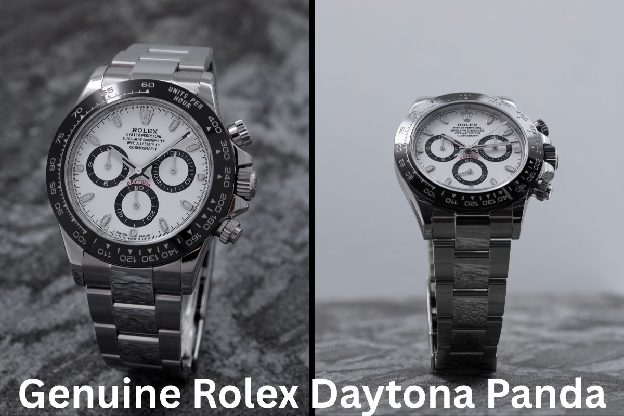
Even with careful research and close inspection, the most reliable way to avoid a fake Rolex is to buy from a trusted, established seller. Modern counterfeits can evade casual scrutiny, and no single visual check can guarantee authenticity without professional evaluation.
Reputable dealers rely on multiple layers of verification, including serial number analysis, movement inspection, case and bracelet examination, and consistency checks across all components. This level of scrutiny requires experience, specialized tools, and direct access to known authentic examples. It also allows experts to identify watches that may contain aftermarket or replacement parts, which can significantly affect value even if the watch itself is genuine.
At Gray & Sons, every pre-owned Rolex is authenticated by experienced watchmakers who inspect each component in-house before a watch is offered for sale. This process ensures not only authenticity but also transparency regarding condition, originality, and service history.
Equally important is accountability. Established and reputable sellers like Gray & Sons stand behind their watches with authentication guarantees. In today’s secondary market, buying with confidence means choosing both the right watch and the right seller.